
I was exposed to North African punk rock by way of a 1985 Maximum Rocknroll “Scene Report” about Tunisia. The country’s premier punk act was a band named Bloody Sheets and they were a complete fabrication. The scene report was a hoax slipped under the noses of MRR’s editors and it fooled me for years as I sought recordings of and information about Bloody Sheets.
As a teenage streetpunk, I understood punk as a movement distinct to the United States and United Kingdom. When I started finding and listening to bands from Spain, Japan, and Scandinavia (I remember G.I.S.M., Sin Dios, and Totalitär impacting me early on), I began to understand punk (and rock ‘n’ roll in general) as a globalized phenomenon. This interest drew me to Tien an Men 89 Records—a label dedicated to releasing bands from the global colonial periphery—and to old Maximum Rocknroll “Scene Reports”—a feature of the zine pioneered by Tien and Men 89’s Luk Haas. I was convinced punk existed everywhere and upon my first stay in Morocco, I knew there must be at least one punk band there and I was set on finding them. In fact, at this time there was exactly one Moroccan punk band: Z.W.M. or Zlaq Wlla Moot, meaning “ride or die” in the local Arabic dialect, Darija. Z.W.M. played skate punk with a touch of ska. Their main influences included bands like Rancid, NOFX, and the Offspring. For a group discovering punk rock by way of skate videos in the early 2000’s, these influences made complete sense.
While visiting Z.W.M. frontman, Zohair Abdellaoui, in his family home, he showed me a Myspace page for the first Algerian punk band: Demokhratia. Unlike the skate punk of Z.W.M., Demokhratia played powerviolence. This wasn’t amateur powerviolence either; their recordings stood up alongside genre standards, such as Capitalist Casualties or Godstomper. I was perplexed. I could understand Z.W.M.’s influences: no local scene preceded them and skate punk, ska, and pop punk were the most popular and accessible punk subgenres at the time. How did Algeria skip these obvious starting points and dive straight into the heavy, esoteric depths of powerviolence? When Toyz asked me to write an article, I took the opportunity to interview Demokhratia and find out. I was given their bassist’s contact info, who for reasons discussed in the interview, preferred to talk under the pseudonym, “el Beghli.” Demokhratia’s vocalist is also referred to by an alias, “el Djifa.” El Beghli currently lives in Montreal and plays in the bands: Uzu and Extraña Humana.
Brian: Hello el Beghli. What do you play in Uzu?
El Beghli: I play the guitar and sing for Uzu.
Brian: We’ll talk about Uzu more, but I also want to ask you about Demokhratia. What did you play in Demokhratia?
El Beghli: I played guitar and did vocals too. We had two vocalists at the same time.
Brian: Where did you grow up?
El Beghli: In Algiers, which is the capital of Algeria. I think it’s important to add, because it shaped the music of Demokhratia, that we grew up during the Algerian Civil War from 1992 until 2002. We were like ten to twenty years old during the war.
Brian: Who was the Civil War between?
El Beghli: It’s very complicated. Before the 1980’s we had one party ruling the country. In the ‘80s Algeria opened up to multiple parties. So we had an Islamic party called Le FIS, the Islamic Salvation Front, and the people voted for them. They won the election but the authorities decided it was impossible to have them run the country. Le FIS wanted to replace the constitution with Sharia’ and have Islamic law rule the country, so Le FIS took up arms and rebelled against the Algerian government.
Brian: Was that the FLN (National Liberation Front) that controlled the government?
El Beghli: Yes. The first party that ruled Algeria after independence from France was the FLN. It’s very hard because this group, le FIS, (that was made up of students and normal people) was fighting against the Algerian military. Years later, people are still asking: how was this possible? Where did they get the weapons? Where did they get the money to fight the Algerian government? It’s hard to understand, but this is what happened. So we grew up amongst the bombs and the killing.
Brian: Was there fighting in Algiers?
El Beghli: In Algiers, yes. We were living in a neighborhood where a lot of things happened at that time, like bombs… everything. In the capital, it was mania. It shaped all our lives. It was daily life for everyone living in Algiers. Everyone suffered from this, because it was not a normal life.
Brian: Did it affect your ability to go to school?
El Beghli: Not in Algiers. I think it did for people living in small villages around the country, but not in the capital.
Brian: How would you describe the neighborhood you grew up in?
El Beghli: Really popular. It was like big blocks of apartments. It was really really popular. I will send you a picture.
Brian: In Morocco they would call it “l’7oma.”
El Beghli: Exactly, a lot of people lived there.
Brian: The architecture is different from what I expected, a lot of big tenement buildings.
El Beghli: The architecture varies from one place to another in Algeria.
Brian: It has a lot of very Soviet-looking construction alongside French colonial architecture.
El Beghli: Yeah, you get it.
Brian: I’ve spent a lot of time in Morocco, but I’ve never seen Algeria. I don’t really know what it looks like, besides what I’ve seen in (the 1966 film) Battle of Algiers.
El Beghli: But you get it because, after independence, Algeria was closely connected with the USSR and a lot of architects from Russia and Poland came to construct buildings, so it’s cool that you can see that in this picture.
Brian: What kind of activities did you see in your neighborhood? What did people do for leisure?
El Beghli: To be honest, there was nothing to do there. When we were kids, everyone would play in the street. People would stand outside, talking and drinking coffee, but there was nowhere to go if you were a young guy.
Brian: No clubs?
El Beghli: No, no, no. Especially [not] at that time. We would play games in the street or we would go to the beach.
Brian: Algiers is on the coast?
El Beghli: Yeah, it’s not far. We’d take the bus and be at the beach in 20 minutes.
Brian: Even with the civil war going on?
El Beghli: Yeah. Well, it would depend on the day.
Brian: What kind of music were you exposed to as a child?
El Beghli: When we were really young we were exposed to Oriental music. Like my mom was a big fan of Oriental classical music.
Brian: Like Fairuz and Umm Kulthum?
El Beghli: Yeah. Well Fairuz was a bit younger than the others, but we would listen to a lot of Fairuz with my aunts. Also, Abdel Halim Hafez and Umm Kulthum. Umm Kulthum was a big singer at that time.
Brian: She was one of the biggest singers in the world. Were you also listening to Raï?
El Beghli: Yes, but Raï came after. When I was like 10 years old Raï became popular in Algeria, because it’s the music of Algeria. Like when I was around 10 years old there was this album of Khaled. Do you know Cheb Khaled?
Brian: Oh yeah. I know Cheb Khaled, Cheb Nasro, Cheb Hasni, Mohamed Raï, etc. I love all the chebs.
El Beghli: There was this album of Cheb Khaled called Kutché and I listened to it a lot. This is the music I grew up listening to.
Brian: Do you think that influenced the music you’ve made? I know it’s very different from powerviolence.
El Beghli: You know, in Demokhratia and Uzu, there are a lot of melodies and all these melodies come from Algerian music and Oriental music.
Brian: Did you discover punk rock or heavy metal first?
El Beghli: At first, it was heavy metal. Metal was popular at one time. It was easier to hear about metal bands than punk. Algeria was a very closed country. You can compare it to Cuba or something like that. No one could afford to travel. It was closed. We knew very little about what was happening in the world. We were just Algerian people living with Algerian people. There was no way to hear about music from outside.
Brian: So you only had Algerian and Arabic music?
El Beghli: But there were like big bands that people knew about. Like people knew about Metallica, but, if you wanted to know about underground music, it was really hard.
Brian: So how did you first hear rock music?
El Beghli: In the early ‘90s we got satellite dishes in Algeria. So, when I was ten or twelve, we started to see TV from around the world and we started discovering music. I was listening to hiphop and things like that. I was listening to French hiphop at that time.
Brian: Who were you listening to?
El Beghli: There was a popular rap group called IAM, if you know this band from France.
Brian: No. I don’t know a lot of French hiphop. I know Rockin Squat and Assassin.
El Beghli: Assassin came before this. Anyway, I met el Djifa, the singer of Demokhratia, and he came from a different type of neighborhood. It was like blocks like where I was living, but he came from a neighborhood where there were a lot of families with connections to Europe and they could travel and would bring music for us. Like I said, metal was big at that time and they would bring back metal cassettes. So el Djifa was living in that neighborhood and he could get music from those people. In highschool, when we were like fifteen or something, he gave me a tape of a metal band—I don’t remember which one—but I was like, “What the fuck? I don’t understand this. What is it?” And, two days later, I was a fan of that music.
Brian: So he would have friends and neighbors going to France and Europe and bringing back cassettes?
El Beghli: Yeah, it was the only way at that time. This was not happening in my neighborhood but, in some places where people could afford to travel, it was happening.
Brian: So el Djifa would share his tapes with you. Were you copying them?
El Beghli: Yes, we were copying the tapes. It was the only way. There were also people collecting tapes and selling copies to whoever was interested, like a music dealer.
Brian: Being a music dealer sounds like a good life.
El Beghli: Yeah, it’s cool but (just to give you an anecdote about this way of hearing music) I had a cousin that was into extreme music, like metal, and he told me about a guy that had a cassette that was labeled “Metallica,” and he was listening to this cassette for years. He was like “I love Metallica.” One day, my cousin went to this guy’s house and he put on the cassette and it wasn’t Metallica. It was a black metal band. Maybe the guy that recorded the cassette made a mistake. He put a Metallica sticker on a black metal tape, so this guy was listening to a black metal band, thinking it was Metallica. So things like that would happen at that time.
Brian: When I was in Egypt I found an official cassette of Cheb Khaled’s self-titled album and, when I played it, it played the first song, “Didi,” and the rest of the album was taped over with Michael Jackson songs. At least I have “Didi.”
So, at this point you were listening to heavy metal. Were you wearing shirts for metal bands?
El Beghli: Yes. We would go to the… how do you say “friperie” in English?
Brian: The second hand store?
El Beghli: Yes. The second hand. In French we call this “friperie” or in Arabic, “el bala.” We used to go there and look out for band t-shirts and sometimes we would find a Metallica t-shirt. I remember I found a Venom shirt. I was really happy with that.
Brian: What kind of music would you hear on the radio? Just Raï and classical Arabic music?
El Beghli: Raï and classical Algerian music, which is called “Cha’abi,” and Oriental music. Only Arabic music.
Brian: Besides you and el Djifa, did you know other people listening to heavy metal music at that time?
El Beghli: Yeah, we knew a lot of metalheads in Algiers.
Brian: Where would the metalheads go to meet and hangout?
El Beghli: Like I said, it was very hard to hangout in Algeria. After school, we would go hangout behind the school. If you knew the right people with cool parents, you could go hangout at their house. At that time, I knew el Djifa, whose parents were really cool. They’d allow us to hangout together, boys and girls, which was really rare. I had another friend, Imane. She had cool parents, communist people, and they were very different from typical Algerian families. They’d allow us to come over and hangout together. In those places, I met the most interesting people I met in Algeria. This was the only way to know cool people at that time.
Brian: So you didn’t hangout much in public?
El Beghli: Yeah, we used to have shows. There were a few bands starting to play at first, and we used to go to their shows.
Brian: What were the bands called?
El Beghli: The first band I remember, maybe the first band to play this extreme music (because there were bands playing hard rock before) [...] was called Litham. This band is really important, because the singer of Litham recorded all three Demokhratia albums. His name is Redouan Aouameur. We were really young and going to Litham shows. It was the only thing at that time and it was really cool. He’s a cool guy. He became our friend, also.
Brian: Do you still talk to him?
El Beghli: I still know him. Now I’m living in Canada. I don’t have social media or anything like that. But, if I need him, I can call him anytime.
Brian: What were some other bands, besides Litham?
El Beghli: There was a really old band called Neanderthalia, but I don’t really remember the other bands they played with. That was like 25 years ago… maybe more. There were a few, but not very many bands.
Brian: You said they were extreme metal. What kind of extreme metal?
El Beghli: Litham was a death metal band.
Brian: Where would they play concerts?
El Beghli: It’s really hard to play shows in Algiers. The only way to play shows was to rent a cinema, because cinemas were closed, so they used to rent them out to host shows for artists. It was cheap to rent a cinema and play a show there. It was places like Cinéma Algérie and Cinéma Zeydoun.
Brian: They didn’t mind that you were playing extreme music?
El Beghli: Sometimes they did, but, if you knew a cool guy, it was possible. They were really old cinemas. They didn’t care about this. They just wanted the money.
Brian: So they weren’t playing movies anymore?
El Beghli: No. They weren’t playing movies.
Brian: Did the police mind you having shows?
El Beghli: At that time, the police had other problems, because the civil war was still happening. They weren’t paying attention to us. We were not a problem for them.
Brian: Remind me, when did the civil war end?
El Beghli: In 2002. The Black Decade. We call it “le Décennie Noir.”
Brian: Were there punk rock bands around at that time or was there only heavy metal?
El Beghli: Only metal bands. I don’t remember any punk bands before us.
Brian: So Demokhratia was the first punk band in Algiers?
El Beghli: No. I was playing in another band called Beghlerass. It was sort of proto-Demokhratia. I can send you the link, because it’s on Youtube.
Brian: Were you in any other bands?
El Beghli: I tried to play in a band before this, but it was not successful. My first real band was Beghlerass. Same for el Djifa.
Brian: How did you start to learn about punk music?
El Beghli: We knew about punk, because some punk bands were really popular, like the Dead Kennedys, or Black Flag, or the Sex Pistols. We knew about punk at the time, but only those bands really. Then, the internet came to Algeria. We had cyber cafés. They were places where everyone would go just to surf the internet and people would sell music there too. You would go there and ask if they had any extreme music and they would give you a CD compilation with a lot of bands, and this was how we would discover music.
After this, we got the internet at home and we started to look for what we were looking for, because we were listening to metal, but we were really not metalheads. We were punk before we knew about punk. Later, when Demokhratia went touring and we saw all the punks in Europe, it was very simple for me to adapt to those people, because I shared all their ethics and everything. It was what I had been looking for all my life.
It’s important to tell you that when Beghlerass and Demokhratia first began, it was a reaction to the local metal scene and the music in Algeria. We wanted something different. I remember going to metal shows and seeing Algerian people playing songs in English. It was really weird. I couldn’t understand why you would sing in English. So, with Demokhratia and Beghlerass, we said, “Okay. Let’s start a band and sing in Arabic.” And just by singing in Arabic, you start to disturb people. Nobody takes someone seriously that sings in English in Algeria. When we started singing in Arabic, we knew it would disturb a lot of people and that is why we did it.
Brian: Was it like an experiment to try to sing rock music in Arabic?
El Beghli: For us it was obvious. Even now, I don’t think I can sing in another language. I’m an Algerian guy. My language is Arabic. I know the meaning and the impact of the words exactly. I can’t imagine singing in another language.
Brian: Z.W.M., the first Moroccan punk band, was the first rock band to sing in Moroccan Arabic. They first tried to sing in Arabic by adapting a cover of “Timebomb” by Rancid and nobody thought it would work, but it did.
El Beghli: It’s really cool. But, for me, it’s obvious. Why would I sing in another language?
Brian: How did people react?
El Beghli: Sometimes we would get a bad reaction, but it was the expected reaction. Those metal bands were bothering no one. They were just there, singing in English. We thought it was naive. So we started to sing in Arabic and sometimes we would get the power shut off on us or we would have people saying, “No, we don’t want this music played in Algeria.” We played some shows in Algeria and sometimes people didn’t know how to act with us. It really disturbed them.
Brian: Did you ever have trouble with people trying to fight you or problems with the police?
El Beghli: Never with the police, because, like I said, the police had other things to do. But with the people you might have an argument depending on where you were playing.
Brian: I read an interview with Demokhratia where you mentioned listening to a band from Argentina, Migra Violenta.
El Beghli: Yeah, we used to love this band.
Brian: In that interview you said that you discovered powerviolence through them.
El Beghli: I don’t remember. At that time we were into extreme music and we were looking for more and more extreme bands. We had a compilation with the grindcore band, Phobia, and some bands from Spain, and between all these bands was Migra Violenta. It was really fresh and different for me. But the most important band for us was Los Crudos, because they were playing punk and singing in their language. It was really cool for us because we wanted to have Algerian Arabic punk music.
Brian: So Los Crudos influenced your decision to sing in Arabic?
El Beghli: 100%. They were the most important for us.
Brian: I’ve heard of two other punk bands in Algeria: N.O.N. and As We Fuck. Were you playing shows with them?
El Beghli: Yeah, one of those guys played in Demokhratia, at one point. I remember, we played a show in Algiers with a thrash metal band.
Brian: Do you remember their name?
El Beghli: It is impossible to remember, because they only played a show or two and then stopped. We played a show together and they were like, “We really love you and want to start a punk band,” and they started As We Fuck. We played together. They were younger than us and they were really cool. One of them came to play in Demokhratia, because we were looking for a drummer to tour with us in Europe in 2010 and 2012.
Brian: What year did Beghlerass form?
El Beghli: I think in 2006. We started to practice in 2005 and we started to play shows around ‘06 or ‘07.
Brian: Then Beghlerass became Demokhratia in 2008?
El Beghli: Maybe 2007, because Beghlerass didn’t last very long. We were active for maybe one year.
Brian: What made you decide to change?
El Beghli: We broke up with the guys we were playing with and then we started Demokhratia right after.
Brian: So it was you and el Djifa that left Beghlerass to form Demokhratia?
El Beghli: Yeah, but at the same time Demokhratia kind of was Beghlerass. You were asking before, how did the band exist? Because, in Algiers, it’s difficult to find places to play music. I remember el Djifa came to me and said, “I know two people that go to this community center and play music and they allow them to use their drumkit and I asked them if they would play with us and they said ‘yes,’” so we met and played music together. They were playing guitar and drums and I had a bass and we played together. It was really hard to find places to practice. For me, finding this place was like a miracle.
Brian: Where was this?
El Beghli: In el Djifa’s neighborhood.
Brian: The community center welcomed you?
El Beghli: Yeah. There was this woman running the center and she was really cool. One day, we went there and the people there were like, “No, no, no. You can’t play here. This year we are having kids play the piano here.” And we went to see her and she was like, “You’re going to practice here and no one will bother you.”
Brian: Is that where you continued to practice?
El Beghli: Yeah. We played there for five years, or something like that. Then, in 2007 or 2009, there were places you could rent to play music, but, before that, it was very difficult.
Brian: Where did you record?
El Beghli: Like I said, this guy from Litham, Redouan, had a studio called Lelahel Studio and he recorded Demokhratia.
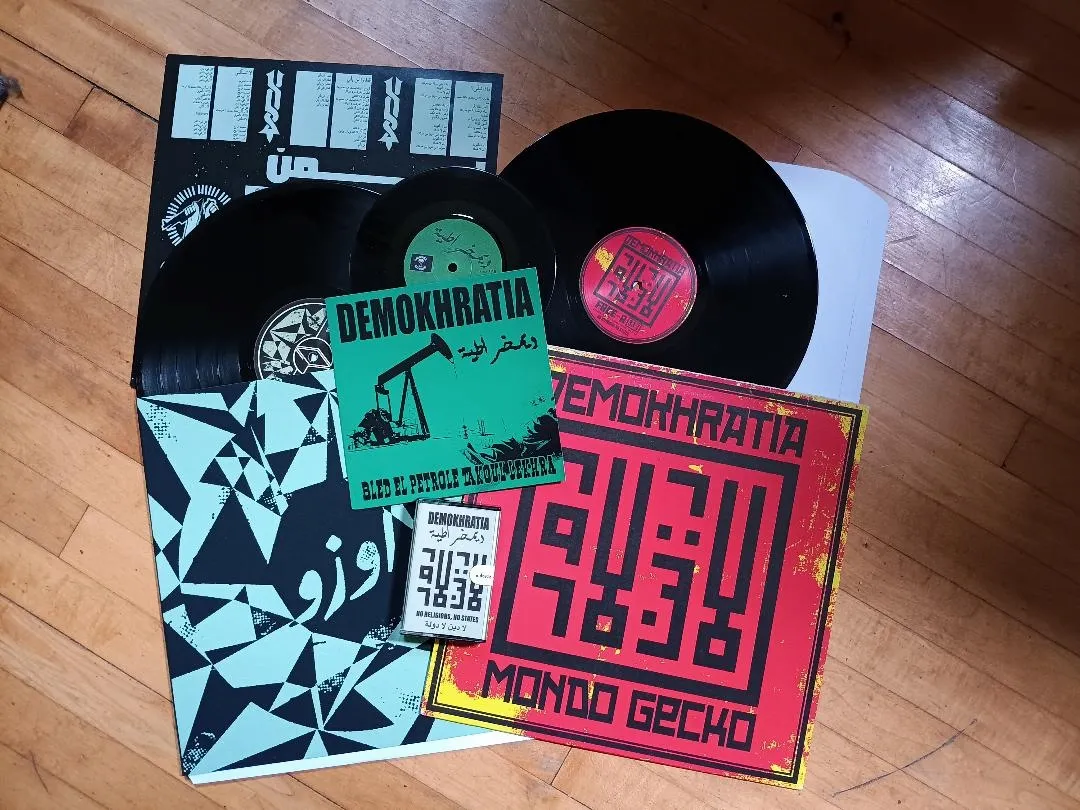
Brian: Was that for the first 7”, Bled Petrole Takoul Lekhra?
El Beghli: Yes.
Brian: How did Luk Haas from Tien an Men 89 Records find you?
El Beghli: When we recorded this album, we put it on Myspace. After a month, he contacted us and said he really liked our music and said, “I want to release this, if you would let me, because I think it’s really important.” We didn’t realize at the time why it was important.
Brian: Had you played outside of the country, at this point?
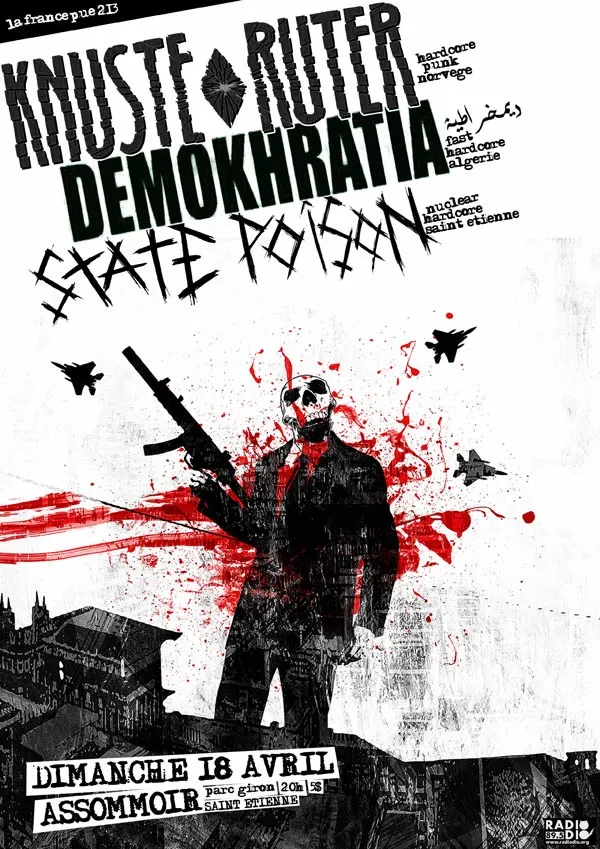
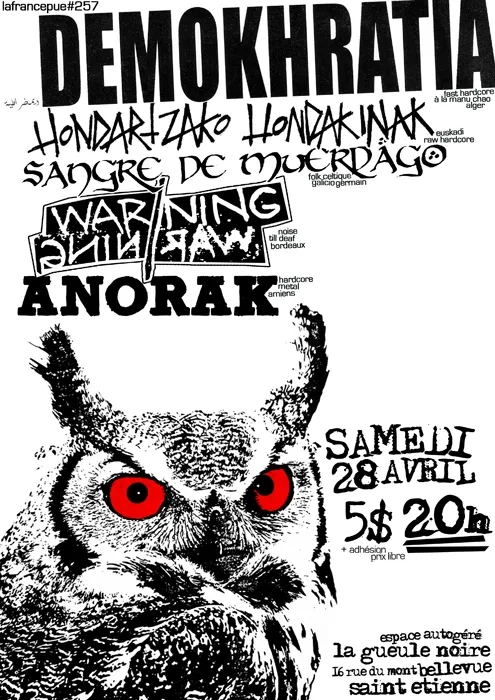
El Beghli: No. Let me tell you about another thing that was important for Demokhratia. When Luk released the album, people started to know about Demokhratia. There was this collective from France, who is really important for the global punk scene, called La France Pue. They are from Saint Ètienne. They contacted us and said, “You should come to Europe to play your music and we will help you do this.” It was impossible for a young guy like me—I was like twenty-four or twenty-five—to travel outside the country. But they had some experience with this. They helped bring some Colombian bands to come play in France. They helped us get a working contract, saying that we were going to come to play at these bars and venues on these dates, and we got our visas, because of those people.
Brian: What year was this?
El Beghli: I think 2009.
Brian: That was your first time leaving the country?
El Beghli: It was my first time leaving the country. Even for my family, I was the first person to travel. Maybe my parents went to Europe in the ‘70s at one time, but, since then, no one had left.
Brian: How was that experience for you?
El Beghli: I discovered a lot of things, because, like I said, Algeria was a very closed country. I went there and I saw the punk scenes, and the DIY ethics, the struggle of minorities in Europe… everything. I discovered all the politics around punk and I was very happy. It was what I was looking for all my life. It was really cool and, like I said, it was really easy for me to connect with those people.
Brian: What countries did you play on your first tour, besides France?
El Beghli: We went to Belgium, the Netherlands, and Germany.
Brian: Did you have more tours after that?
El Beghli: Yeah, we toured like two times. One time only in and around France and the second time was in like 2012 and we toured all around Europe. We went to Norway, Poland, Denmark, Germany, the Netherlands, and the Czech Republic.
Brian: Did you bring your own gear?
El Beghli: We brought only our guitars and the people were really nice and let us use their amps. At that time, playing through La France Pue, we toured for free. We didn’t have to pay for anything except for gas. They just wanted us to come and play and everyone helped, sharing amps and even the drum breakables.
Brian: What were some of your favorite bands you played with on your tours?
El Beghli: The most memorable for me was La Casa Fantom. I think they were from Norway. They were like an anarcho band with bass and drums. You should see this band live, if you can.
Brian: Are they still around?
El Beghli: Yeah. They’re an old band now, but they still play.
Brian: Going back to the community center, did they have instruments for you to use?
El Beghli: Only the drums. When I got my first job after school around 2009, I was a graphic designer, and I bought a bass and an amplifier.
Brian: Where did you buy those?
El Beghli: I don’t remember. Not at a shop, but somebody sold me this stuff.
Brian: In Morocco, skateboarding and extreme sports helped connect all the people in the punk and metal scenes. Were kids skating in Algeria?
El Beghli: No. Something that was very important in Algeria was colonization. Algeria was colonized for 130 years and colonization in Morocco only lasted for forty years. In Algeria, it was a big genocide. A million people were killed during this period of 130 years. People were deported and depossessed. A lot of awful things happened. So after this, in Algeria, people started rejecting everything that came from the Western world. Because those colonizers were supposed to bring civilization, but instead they brought death. I understand this. So, if you go to a popular neighborhood, skateboarding, it’s like…no one would say this, but it’s like “we fought against those people for years to be independent, to get those people out of our country, and you start to act like them.” So it could be seen as provocative to those people and a bad thing to do, to start to look and dress like European people. This is why extreme music and rock music in Algeria is something rare.
Brian: And if people in your neighborhood saw you wearing a Metallica shirt, would that be a problem?
El Beghli: No. You would have people staring or something like that. We want to do whatever we want to do and dress how we want to, but at the same time we understand this. We understand why the people don’t want that anymore.
Brian: What did your parents think of the music you were playing and listening to?
El Beghli: I’m not really sharing this stuff with my parents, but they know I play music. I remember, when I got my visa for touring with Demokhratia, I went to my parents and said, “I am going to play music in Europe,” and they were like, “What? You?” and I was like, “Yes, I’m in a band.” They didn’t believe me but then they saw a photo of us after the tour and they said, “We couldn’t imagine this.”
Brian: Were they happy for you?
El Beghli: Yes, they were happy for me. My parents are cool.
Brian: So what does Demokhratia mean?
El Beghli: Did you learn some Arabic in Morocco?
Brian: Chouiya.
El Beghli: So do you know what “khra” means?
Brian: Yeah. I know all the bad words.
El Beghli: So you know “khra” means “shit” and “democratia” means “democracy,” so it’s like a word play to say democracy is shit. Not just talking about Algerian democracy, but democracy all around.
Brian: How did you come up with this name?
El Beghli: I don’t know. El Djifa came up with this name and I thought it was really cool.
Brian: Your first EP was called Bled El Petrole Takoul Lekhra. What does that mean?
El Beghli: Like “bled el petrole” means “oil country,” and “takoul lekhra” means “eat shit.” But we say “bled el petrole” to refer to a rich country where people are starving.
Brian: So are you talking about Algeria?
El Beghli: We are talking about Algeria. A country rich in oil, but people are starving.
Brian: You released a split with Mondo Gecko. What year was that?
El Beghli: Yeah. 2012, I think it was.
Brian: How did you meet Mondo Gecko?
El Beghli: We never met Mondo Gecko. It was really hard to meet them, but we were introduced by the anarcho punk community. People from France, from the anarcho punk community, who knew them personally. They were interested in the same things. If you’ll allow me to talk about this, for me it’s really important, because I want to talk about this split. I want to make things really clear, because I got people surprised, being like “why would you do that split?” People from everywhere. They were sometimes surprised about this, but the anarcho community understood the point of this record. Why I’m saying it’s hard for us and sometimes dangerous, is because we did this split. You have to know that Algeria doesn’t recognize the state of Israel. It’s really different from Morocco. For example, if someday I go to Israel and I get the stamp of Israel on my passport, I will never come back to Algeria, because they will put me in jail. It’s like a big betrayal. We have no contact with them and we should have no contact with them. Just because we did this split, if something happens, they can use that against us. It could be seen as a betrayal. But the goal behind this split is to say “those are anarchist people just like us, against their religion and against their government” and we are together saying we are like brothers against those religions and those states.
But the problem is, if you ask me about this and what I am, depending on the situation, if you ask me, “Beghli are you a Muslim guy? You come from Algeria,” and are islamophobic, I’m a Muslim guy to you. But if you are someone that wants to use religion to oppress people, I’m not Muslim. I can be both at the same time and this is why this split was done. What I mean to say is, we will stand with muslim people to defend them from colonialism and at the same time we will stand with people who want to break free from Islam to defend them against extremism.
Brian: So is the Mondo Gecko split the reason you wanted to remain anonymous in this interview?
El Beghli: Yes, because in Algeria it’s something that can be used against you.
Brian: Well yeah. You want to go back and visit your family and stuff.
El Beghli: Exactly.
Brian: Do you visit them often?
El Beghli: I went three times since I have been living here.
Brian: The Mondo Gecko split has seven record labels behind it. That’s not really a question. I’m just saying, I’ve noticed in South America and Europe, it’s common for like four to ten record labels to split releasing a record to save the cost of it. Is that what happened with that split?
El Beghli: Yeah. It’s a cool thing.
Brian: So you left Algeria in 2019. Did you leave by yourself or did el Djifa leave with you?
El Beghli: Just myself. Me and my partner, we left Algeria.
Brian: How was the process of getting a visa?
El Beghli: Canada offered an immigration program; a sort of lottery, like a system of points and they count your points and if you reach enough points you are selected.
Brian: What do you have to do to get points?
El Beghli: You have to have a specific job. If you speak French, there’s some points. If you speak English, that’s more points. Stuff like that. If you have kids or don’t have kids, it depends.
Brian: This is specifically for Canada?
El Beghli: Yeah. Canada was doing this. It was the only country doing this.
Brian: Demokhratia released a tape in 2020?
El Beghli: Yeah, just before I moved.
Brian: It was with A World Divided tapes. That was the last Demokhratia release. Is the band still active in any form?
El Beghli: No. I’m living here in Canada. El Djifa is living in Algeria. It’s just not possible.
Brian: You wouldn’t play a show if you were visiting Algeria?
El Beghli: No, I don’t think so.
Brian: I don’t have as many questions about Uzu, but let’s see. Uzu formed in Canada?
El Beghli: In Canada. Yeah.
Brian: How did that happen?
El Beghli: It was during the pandemic. We met with our friend, Gustavo, and were hanging out and we knew he was a drummer. I had been playing in a band with my partner. She was playing the bass and I was playing guitar, and we were hanging out with Gustavo and we said “let’s try to play music together.”
Brian: And you continue to sing in Arabic.
El Beghli: Yeah, but the difference between Demokhratia and Uzu is that I sing in classical Arabic this time, not in Darija.
Brian: Was that difficult?
El Beghli: Not for me. Like the influence from the Oriental music has helped me a lot.
Brian: That makes sense. What does Uzu mean?
El Beghli: It’s a plant. In French it’s called “genêt”...or “genista.” It’s a plant that is popular in North Africa.
Brian: What is the significance of this plant?
El Beghli: It’s a popular plant in North Africa… in Kabyle, which is my origin. It’s this, but, at the same time, it means “pain.” It’s not in Arabic. It’s in Berber. In Algeria, we are like a Berber and Arab people. So we thought we could call it Uzu, like this plant, but, at the same time, it means “pain.”
Brian: Uzu has been playing a lot of shows. You are on the No Genocide compilation.
El Beghli: Yes. We have been playing a lot of really political shows, to raise money, and I’m really happy to be a part of this community. There are a lot of people that are doing a lot of things for helping Palestinian people, like the people from Noise Not Borders. We played the Yell Out, which is a feminist festival. I’m very happy to be a part of this with Uzu.
Brian: Do you have any future plans with Uzu?
El Beghli: We are going on tour this May, in France, and maybe a third record, if we have time for it.
Brian: Awesome. Thank you for taking time to talk with me and have a nice tour.